
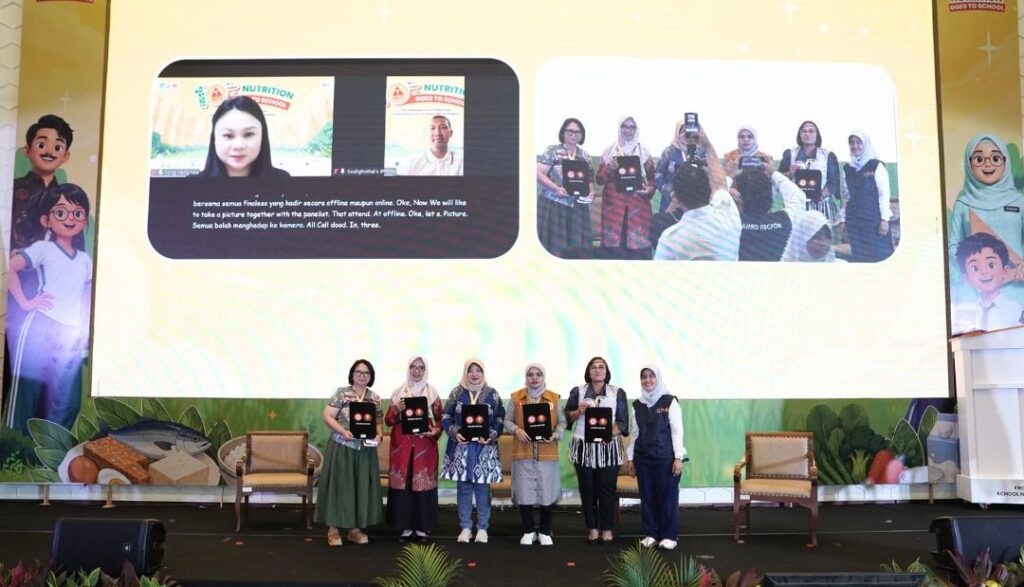
Jakarta, 23 August 2026 – As SEAMEO RECFON celebrates the 10th anniversary of Nutrition Goes to School (NGTS), the role of schools as drivers of change in promoting healthy eating and nutrition education took centre stage during an interactive panel discussion titled “NGTS Schools in Action: Impact for AWESOME Generations.” Held as part of the hybrid anniversary celebration at Plaza Insan Berprestasi, Ministry of Primary and Secondary Education of the Republic of Indonesia, the session brought together representatives from four model schools across Indonesia, alongside regional partners from Malaysia and Lao PDR.
Moderated by dr. Yesi Crosita Okta, M.Sc, Ph.D, Lecturer in Community Nutrition at UPN Veteran Jakarta the discussion explored how schools have transformed nutrition education into practical initiatives while addressing challenges such as limited resources, parental engagement, limited space, and demanding academic curricula. The stories also highlighted how the NGTS approach continues to inspire the development of AWESOME generations-Active, Well-nourished, and Smart of Me through locally driven and sustainable action.
Representatives from four NGTS model schools shared how they adapted nutrition education to their respective school environments, cultures, and available resources. At SDN 176374 Dolok Nauli, Toba, North Sumatra, School Principal Launa Yeni Abadi Simanjuntak highlighted the integration of nutrition into learning activities. The school developed six original co-curricular modules on healthy food, introduced educational nutrition models and the Isi Piringku campaign, and incorporated environmental activities into its programme. These initiatives were brought together under “Nature,” a Batak expression meaning “very good.”
At SMPN 7 Kota Cirebon, West Java, School Principal Eis Sulastri shared the school’s transformation of its healthy canteen and school environment. In collaboration with the local health laboratory, the school developed a healthy canteen that complies with food safety and halal standards. Despite being located in a densely populated area, the school also established a “School Forest” featuring more than 20 types of fruit trees. The school further introduced quail and chicken farming, producing hundreds of quail eggs each day. Beyond providing a source of animal protein and hands-on learning, these activities also introduced students to entrepreneurship. The school has also shared its practices with neighbouring schools, including initiatives to process dragon fruit peels into healthy sauce.
At SMAN 1 Singosari, Malang, East Java, teacher Wiwi Widati described the school’s efforts to promote healthier lifestyles through peer engagement. Its “Hebat Juara” healthy canteen promotes healthier food choices while implementing cashless payment and reducing single-use plastics. The school also runs “Remaja Asik”—Aktif, Sehat, Pintar, Kreatif (Active, Healthy, Smart, Creative)—and nutrition ambassador programmes to support peer counselling. Other activities include mushroom and catfish farming, a vegetable-eating campaign known as Gemas (Gerakan Makan Sayur), and regular iron supplementation.
Meanwhile, MTsN 2 Bantul, Special Region of Yogyakarta, represented by teacher Susanti, combines nutrition education, physical activity, and environmental awareness through its “Jumaria” (Jumat Ceria) programme. The weekly activity brings together Qur’an memorisation, exercise, and shared nutritious breakfasts. The school also manages a healthy school garden, develops catfish farming and aloe vera-based products, and incorporates environmental education through an ecotheology-based curriculum. Together, these examples demonstrate how NGTS can be adapted into practical and locally relevant programmes, rather than relying on a single model or approach.
At REAL International School (REAL School), Malaysia, in partnership with Dr. Yong Heng Heo from IMU University, the program focused on translating capacity building and action plans into hands-on student activities. Initiated in 2023, the collaboration engaged school management, teachers, and canteen representatives to establish a strong foundation of readiness. IMU University integrated its nutrition and dietetics students into selected school activities and invited REAL School students to the university campus for interactive, experiential learning on healthy eating and practical nutrition. The partnership emphasized that long-term sustainability relies on shared ownership among a school team rather than a single champion, embedding nutrition into existing school routines, and conducting ongoing orientation and monitoring
In Lao PDR, the pilot program was launched in October 2023 across three primary schools in the remote Sangtong district, under the guidance of Dr. Souli Gotay from the National Nutrition Center, Ministry of Health. Teachers were trained to design balanced daily menus using local ingredients and integrate nutrition education with essential hygiene routines like handwashing and clean water. The program implemented climate-friendly practices, including plastic reduction, organic farming, and school gardens utilizing soil and hydroponic systems. These gardens served a triple purpose: promoting physical activity, serving as outdoor classrooms, and supplying nutrient-dense produce to support the school lunch budget of 10,000 Kip per child. Despite challenges in remote monitoring, the pilot highlighted that sustainability requires strong local ownership, active community engagement, and multi-sectoral synergy between health and education ministries
The discussion concluded with a reflection from Wiwi Widati on the importance of leadership and commitment in sustaining school nutrition initiatives. She recalled that introducing healthier eating habits among high school students was not always easy and initially faced resistance. However, the school remained committed to its original goals, supported by strong school leadership and policies that enabled the team to continue its work.
The experiences shared during the panel demonstrated that sustainable nutrition education does not necessarily require extensive resources. Strong leadership, collaboration, community participation, and the ability to integrate nutrition into existing school activities can create meaningful and lasting change. As SEAMEO RECFON celebrates 10 years of NGTS, these stories from Indonesia, Malaysia, and Lao PDR reflect how nutrition education can grow beyond individual programmes and become part of a broader culture of healthy living. More importantly, they demonstrate the power of schools to become centres of change—nurturing AWESOME generations that are Active, Well-nourished, and Smart of Me.