
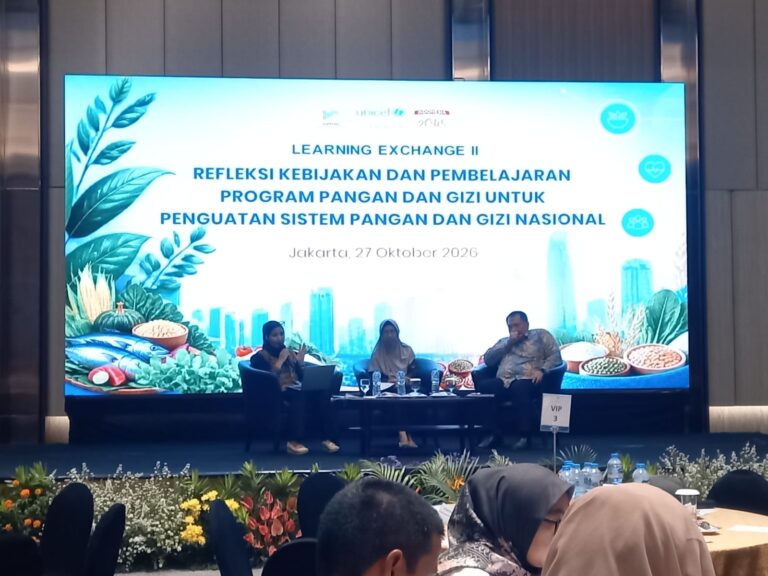
Jakarta, November 2, 2026 – SEAMEO RECFON contributed to strengthening the national food and nutrition system by presenting the results of the development of the Guidelines for a Balanced Diet Based on Local Foods (PGS-PL) at the “Learning Exchange II: Policy Reflections and Lessons Learned from Food and Nutrition Programs for Strengthening the National Food and Nutrition System” event. This event was part of the 12th National Food and Nutrition Workshop (WNPG) 2026, organized by the Ministry of National Development Planning/Bappenas together with development partners on Tuesday, October 27, 2026, at the JS Luwansa Hotel in South Jakarta.
During a panel session titled “Reflections and Lessons Learned: Implementation of Large-Scale Nutrition Interventions,” Dr. Umi Fahmida, an expert and speaker from SEAMEO RECFON, presented the development of the PGS-PL as an approach to optimize the use of local food to meet the nutritional needs of the community. These guidelines were developed by taking into account the diversity of consumption patterns, food availability, and food characteristics in each region.
The PGS-PL was developed for three target groups: pregnant women, infants and toddlers aged 6–59 months, and school-age children and adolescents aged 7–18 years. It was developed using linear programming via the Optifood software to identify nutrient gaps, select nutrient-dense local foods, and create food combinations that can help meet nutritional needs while taking into account dietary habits and affordability. This guide complements the national Balanced Nutrition Guidelines by providing more specific food recommendations tailored to the local context.
During the discussion, Dr. Umi Fahmida also highlighted the importance of understanding local foods more broadly. According to her, a local approach is not only related to the types of food consumed but also encompasses their definitions, preparation methods, and processes, all of which must take into account the specific conditions of each region.
“So, the food itself is also local. Its definition still needs to be discussed, as do the methods and preparation processes,” said Dr. Umi Fahmida.
The presentation also indicated that various local foods have the potential to support nutritional needs, but their utilization in daily dietary patterns still needs to be optimized. A number of food items such as fish, eggs, chicken liver, tempeh, tofu, legumes, green vegetables, and fruits can be part of nutritious food choices tailored to the availability and consumption habits of the local community.
Nevertheless, the use of local foods must be accompanied by attention to nutrients that are still difficult to obtain through daily meals. The study results presented indicate that iron, zinc, folate, and calcium remain areas of concern for certain age groups. Therefore, strategies to meet nutritional needs must be supported by other appropriate interventions, such as food fortification and supplementation.
In addition to the presentation by SEAMEO RECFON, this panel session also featured a representative from the National Food Agency (Bapanas) who discussed policy directions for the diversification and utilization of local foods. The discussion also involved panelists from GAIN Indonesia, the People’s Coalition for Food Sovereignty (KRKP)-KSPL, and Pergizi Pangan to enrich the discussion on access to nutritious food, the alignment of local production with community needs, and the strengthening of nutrition education.
Through the development of PGS-PL, SEAMEO RECFON is helping to ensure that the potential of local foods can be translated into more practical dietary guidelines for families and communities. Its utilization can also be strengthened through various services and programs, such as Posyandu, Holistic Integrative Early Childhood Education (PAUD-HI), schools, and nutritious food provision programs.
SEAMEO RECFON’s participation in Learning Exchange II is part of its contribution based on research and implementation experience to support discussions on national food and nutrition policies. The various lessons learned gathered during this event are expected to serve as input for formulating recommendations for the 12th National Food and Nutrition Conference (WNPG XII), while also strengthening efforts to realize a national food and nutrition system that is adaptive to the diversity of local food potential in Indonesia.