
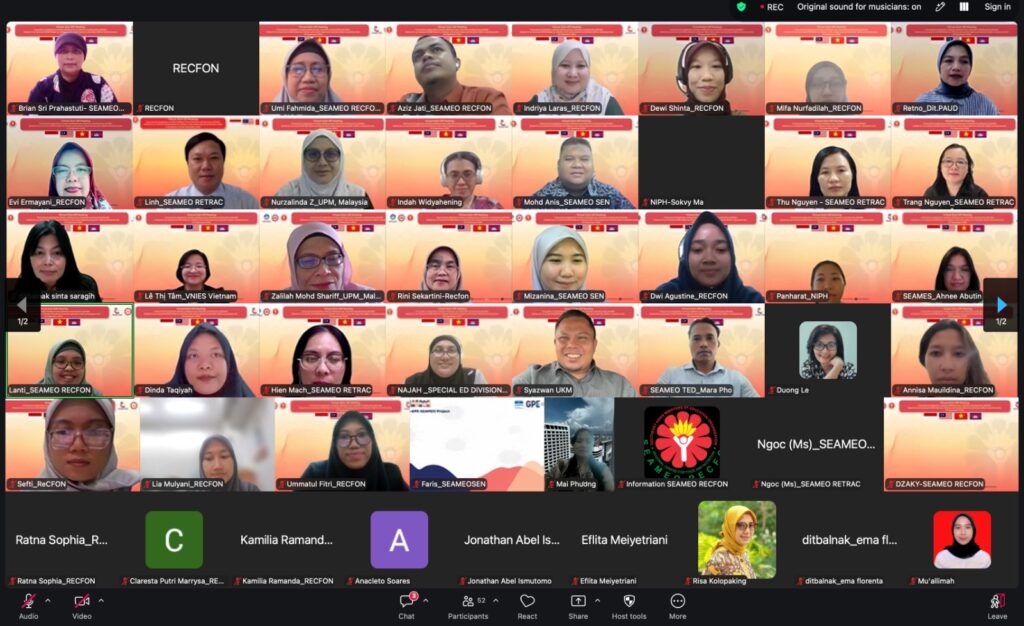
Jakarta, September 23, 2026 SEAMEO Regional Centre for Food and Nutrition (SEAMEO RECFON) led the implementation of the Kick-Off Meeting of the Inter-Centre Collaboration (ICC) project entitled “Transcultural Adaptation of Early Childhood Care, Nutrition and Education (ECCNE) Module for an Inclusive ECCNE Model for Children with Autism Spectrum Disorder (ASD) in Southeast Asia”. The meeting took place online via Zoom at 13.00–16.00 WIB (GMT+7), attended by the Steering Committee, Technical Working Group, academic partners, and representatives of the ministries of education from four Southeast Asian countries, namely Indonesia, Malaysia, Vietnam, and Cambodia.
As the Lead Centre in this regional project, SEAMEO RECFON collaborates with SEAMEO SEN (Malaysia) and SEAMEO RETRAC (Vietnam) as Co-Impelenting Centres, together with academic partners from the University of Indonesia (FKUI), Universiti Kebangsaan Malaysia, Universiti Putra Malaysia, National Institute of Public Health Cambodia, and National Institute of Nutrition Vietnam. This cross-border collaboration was initiated to address the gap in early childhood care, nutrition, and education services for children with ASD.
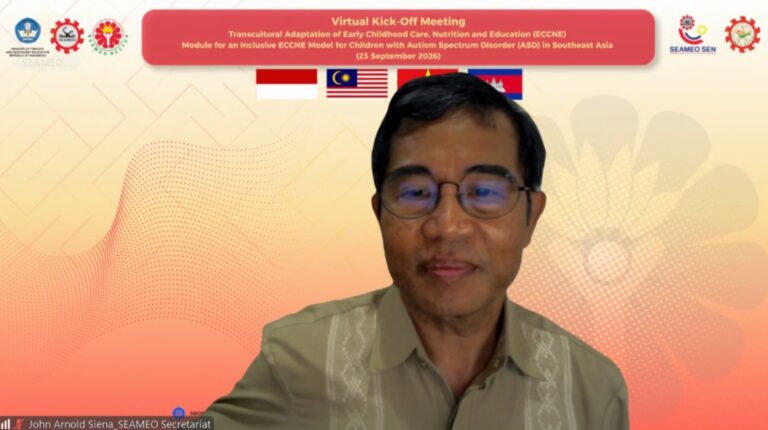
In his remarks, the representative of the SEAMEO Secretariat, John Arnold Siena, emphasized that the problem of early childhood care and education, especially for children with ASD, cannot be solved by one party alone and requires cross-border collaboration. In his remarks, the representative of the SEAMEO Secretariat emphasized that the problem of early childhood parenting and autism, especially for children with ASD, cannot be solved by one party alone and requires cross-center collaboration with relevant expertise.
“The problems that affect our children cannot be solved by one sector, one institution, or one country alone… We know very well that the early years of life provide the foundation for lifelong health, learning, development, and participation… These challenges cannot be solved by one institution or one center alone. It requires collaboration, sharing of skills and knowledge that is done clearly and responsibly in the local context,” said John Arnold Siena of the SEAMEO Secretariat.
Led by Dr. Umi Fahmida as Project Principal Investigator (PI), this project aims to develop and validate ECCNE ASD modules that have been adapted according to the local context of a country. This module is designed to be a reference for an inclusive service model that accommodates the needs of early childhood with ASD, ranging from aspects of nutrition, health, to educational approaches in the school and family environment.
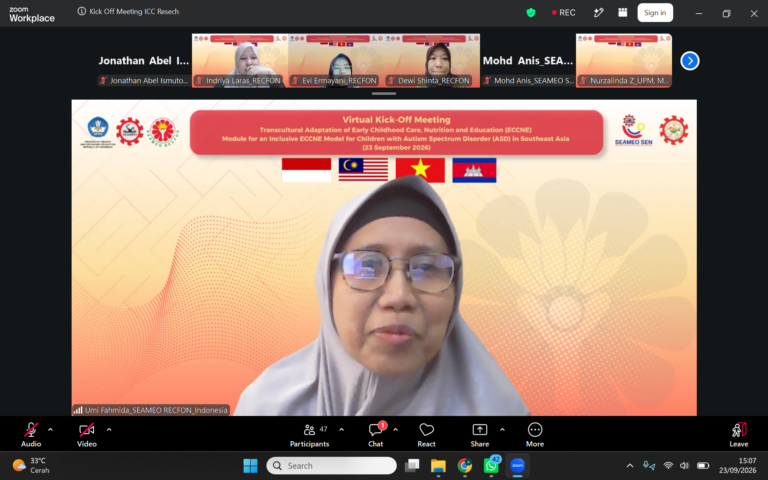
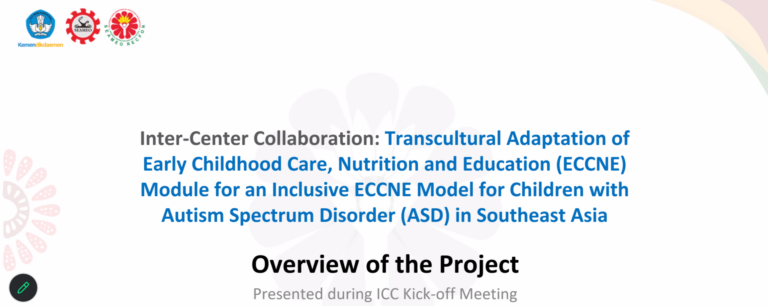
In the Country Perspectives session, representatives from the Ministry of Education from Indonesia, Malaysia, and Vietnam presented the current situation of ECCNE and ASD services in their respective countries. This session provided a comprehensive overview of the challenges faced by each country, as well as the basis for the project team to design an adaptation approach that is appropriate to the local context.
The Three Main Pillars of Work
The meeting also discussed three Work Packages (WP) that became the framework of the project:
WP1: Pillars of Nutrition and Health (including the Local Food-based Balanced Nutrition Guide, coordinated by SEAMEO RECFON;
WP2: Pillars of Nurturing and Education, coordinated by SEAMEO SEN;
WP3: Leadership and Strengthening the Education System, coordinated by SEAMEO RETRAC, focuses on how principals can lead in effectively implementing inclusive ECCNE programs at the school level, including the provision of guidance and monitoring tools.
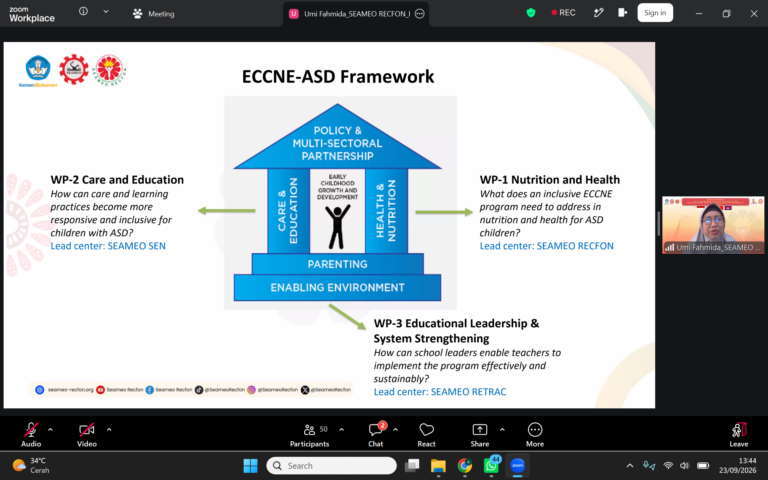
The Roles, Responsibilities, and Collaboration Mechanisms session discussed in detail the division of roles between parties: SEAMEO Center is responsible for workpackages 1, 2 and 3, academic partners play a role in research, evaluation, and provision of scientific evidence, while the ministry of education plays a role in policy alignment and scaling up programs at the national level. Inter-agency communication mechanisms were also discussed to ensure effective project coordination in all participating countries through established Country Focal Points (CFPs)
The Forum also presented an open discussion session with three key guiding questions: the most pressing ASD-related ECCNE challenges in each country, module components that require adaptation to local contexts, and the resources and partnerships that are already available in each country. These discussions were important inputs for the Technical Working Group (TWG) team in developing the next phase of work plans.
Dr. Umi Fahmida as Project Principal Investigator (PI), expressed optimism that this collaboration can strengthen joint resources between participating countries, while emphasizing that the journey towards a more inclusive education model for children with ASD will continue not only during the one-year project period.
Through this regional initiative, SEAMEO RECFON affirms its commitment to continue to build an inclusive and supportive early childhood nurturing, nutrition, and education environment for children with ASD in the Southeast Asian region in line with SEMESIO’s vision of strengthening the quality of human resources from an early age in all member countries.